
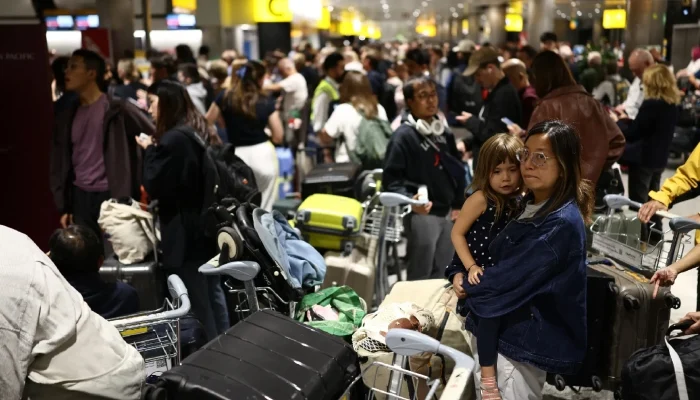
Thousands of flights grounded in the UK after a millisecond software error brought air traffic to a halt.
The air traffic outage that grounded thousands of flights and disrupted hundreds of thousands of journeys across Britain earlier this month happened because of a software fault that occurred in a millisecond, a preliminary investigation by the UK’s National Air Traffic Services (NATS) has said.
It was not caused by a cyberattack or sabotage or military intervention, NATS said. Rather, it was found that the cause of the failure lay in a small element of software that is used in the National Airspace System (NAS) which supports airspace management in the UK.
The defect contaminated data which is used to update information pertinent to flying, and that caused the air traffic controllers to limit the number of planes in the country’s airspace in order to keep flying safe. The software issue was for flights being controlled by the London Area Control Centre, but it was necessary for restrictions to be imposed throughout the UK to enable the NAS to be restarted and flight data reloaded.
How the software failure unfolded
The preliminary investigation found that the problem began while the system was processing a manual request for an aircraft identification code. These codes are usually assigned automatically, and are used to identify aircraft on radar.
A message was received for a higher priority activity while the request is being processed. This put the aircraft-code request on hold. The software defect caused the resumed original request not to continue properly and resulted in corrupted output which impacted subsequent flight data requests.
The critical sequence took place within a millisecond,” said NATS. The first mistake was around 10am on September 8, but it took about 2.5 hours to realize the severity of the error.
When the magnitude of the air traffic problem became apparent, air traffic was restricted. They stayed there for approximately 6 hours and NATS worked to restore the system. Normal NATS operation brought back up that evening but the overall disruption was continued for a lot longer whilst airlines and airports cleared the backlog.
The outage caused approximately 2,000 flights to be cancelled and hundreds of thousands of travelers’ plans to be affected. People were stuck overnight at airports such as Heathrow as the disruption cascaded across the aviation network.
Review ordered as pressure grows on NATS
Martin Rolfe, NATS chief executive, said he apologised to passengers who were affected by the incident and that NATS had identified the software problem. A mitigation measure has been implemented in the meantime to ensure a safety test and preparation of a permanent fix.
The latest outage was not linked to the August 2023 major NATS failure, which resulted in further disruptions and an estimated cost of £100 million to airlines, Rolfe also said. In July 2025, there were approximately 150 cancellations due to a separate technical issue.
The incident has also led to demands for more accountability. The previous failures have led to repeated demands by Ryanair for Rolfe’s resignation and an independent inquiry by the UK Civil Aviation Authority has been ordered by the government. Transport secretary Heidi Alexander said the latest disruption was unacceptable.
NATS said that safety was not affected during the outage as controllers imposed limitations and had procedures to deal with the lesser information available to them. Over the past 10 years the company has put in over £1 billion for systems and technology, and is proposing to invest further £1 billion by the end of 2033 with the CAA.
The preliminary probe has found the immediate software cause and the independent inquiry is likely to cover the general management of the incident and the strength of Britain’s air traffic control network.
