
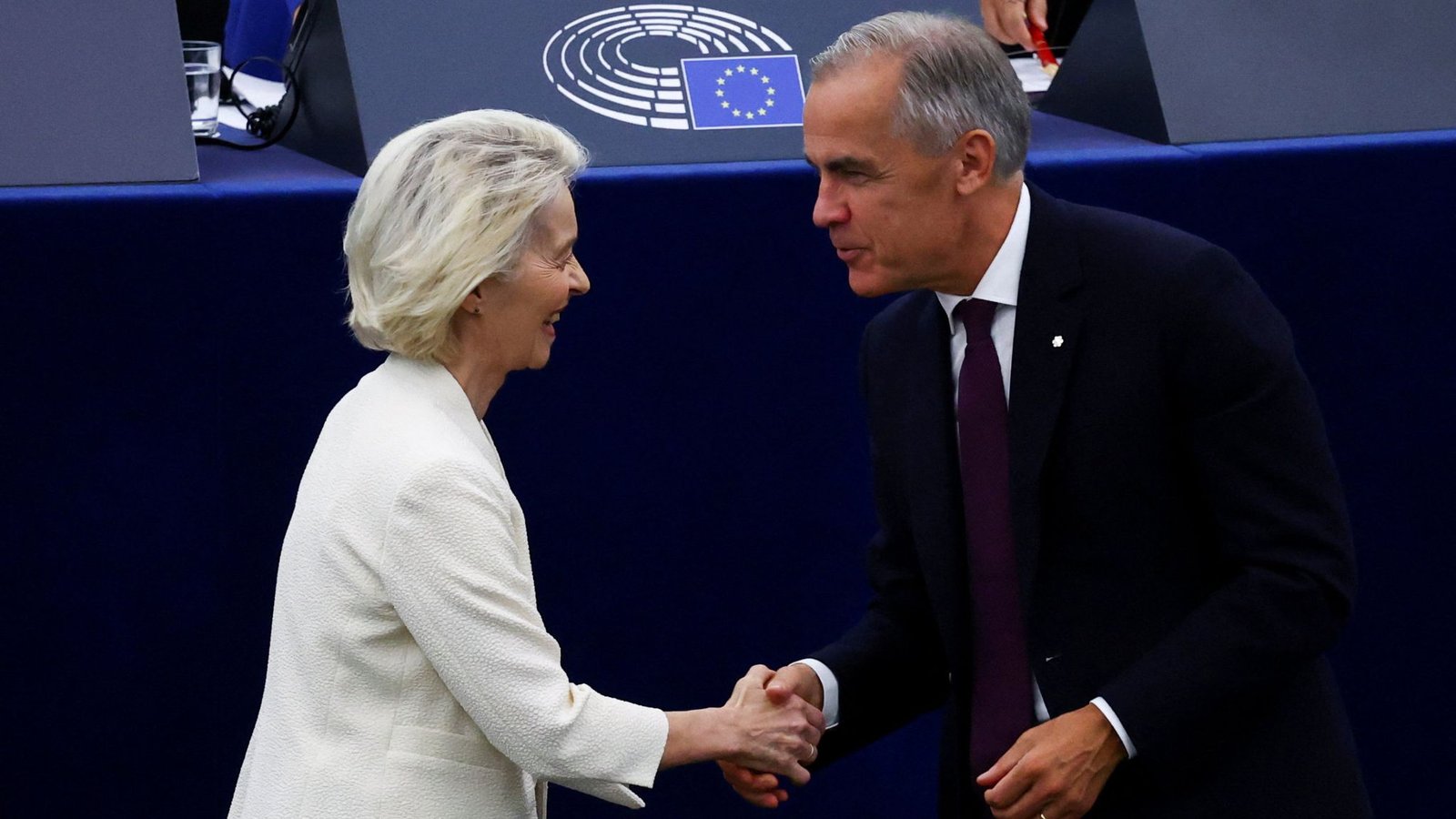
European Commission (EC) President Ursula von der Leyen has suggested that Canada become the first “associate member” of the European Union (EU), paving the path for closer ties between the bloc and Ottawa.
The proposal was made by von der Leyen on Wednesday at a Strasbourg address she delivered on the State of the European Union, which was attended by Mark Carney, the Canadian Prime Minister.
The EU and Canada have common interests on artificial intelligence, climate change, the Arctic, defence and critical minerals and supply chains, she said. She suggested that there is a need to establish closer cooperation in those fields and establish a new form of partnership.
Canada does not want to become a full member of the EU. Instead, Carney has been touting what he described as a “unique alliance” with Europe, a move that would see Ottawa seek to expand ties away from the U.S.
The offer is a response to a dramatic deterioration in the relations between Canada and the United States. But trade negotiations between Ottawa and Washington stalled last month, and retaliatory tariffs and tensions have escalated between the two countries.
The proposed partnership would include manufacturing, technology, energy and defence, said Von der Leyen. She also spoke about the need for cooperation in the Arctic region, which is becoming increasingly important for both Canada and Europe.
There is no treaty basis for an Associate-Member status in the EU. The proposal by von der Leyen is thus a new scheme that would have to be negotiated between Canada and the bloc.
More work is to be done at a Canada-EU summit in October in Montreal, where both sides will look at how the proposed relationship can be developed.
Additionally, Von der Leyen emphasised that the partnership would not be “against anyone else,” indicating that the proposed closer ties with Canada were not aimed directly at the United States.
